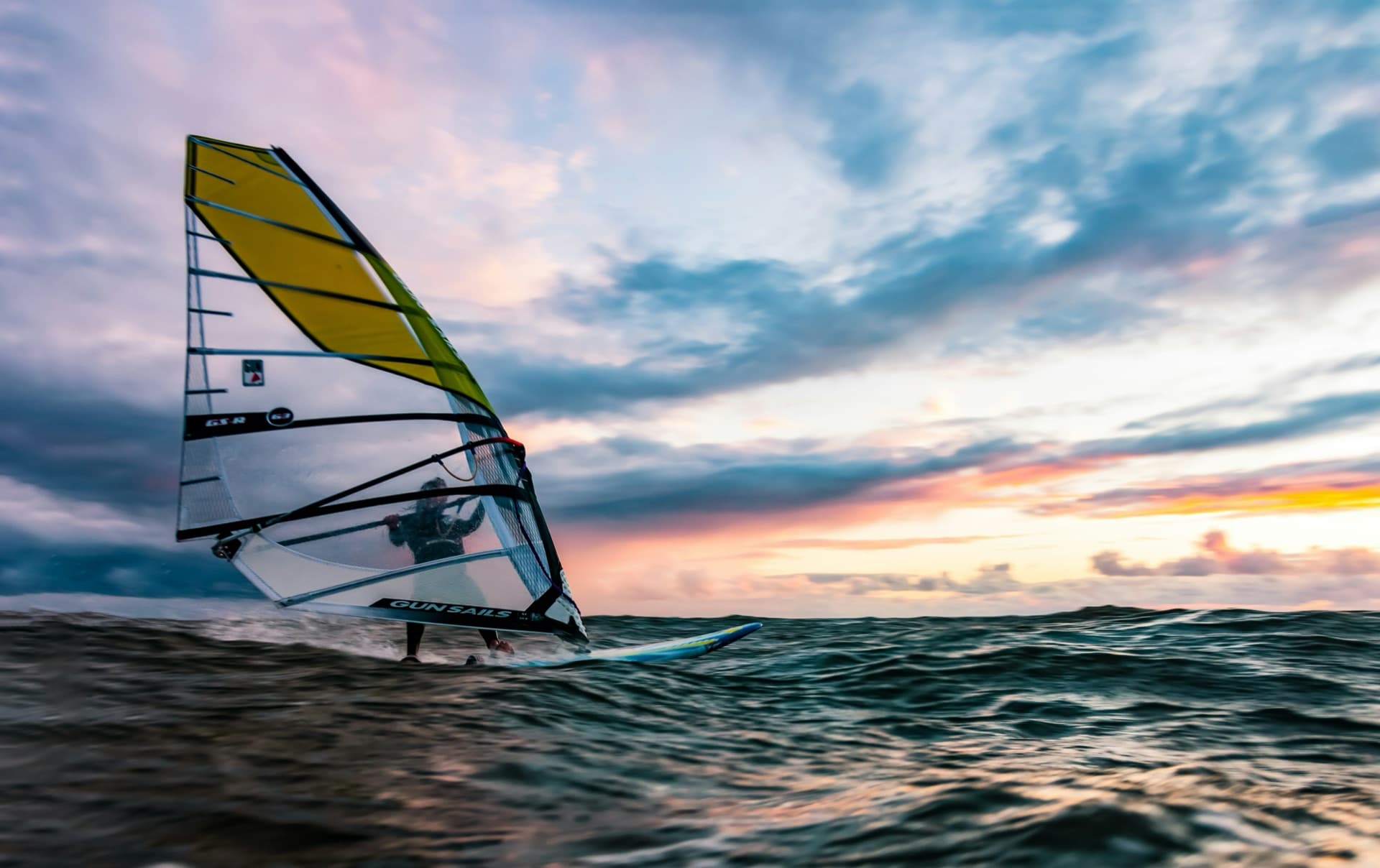
"What size sail do I need?" is the question every windsurfer asks on the beach, and the answer comes down to three things: how hard the wind is blowing, how much you weigh, and the board under your feet. Get them right and you plane early, stay in control, and ride for hours. Get them wrong and you are either bobbing around off the plane or fighting a rig that wants to launch you. Here is how to think about it, with a chart by rider weight you can actually use.
The three things that decide it
- Wind strength. The big one. More wind means a smaller sail, and a single sail covers a useful band of wind before it is too little to plane or too much to hold.
- Your weight. A heavier rider needs more power (a bigger sail) to get planing in the same wind; a lighter rider needs less and gets overpowered sooner.
- Your board. This is the windsurf-specific twist that kiters never deal with. A high-volume freeride board planes earlier and carries a bigger sail; a small wave or freestyle board needs more wind and a smaller rig. Board volume sets your low end as much as the sail does.
The charts, by skill level
These show the wind range each sail carries, by rider weight, for a freeride rig (read off the average wind, not the gusts). They are the same ranges Windmaster uses to size your sail. The better you ride, the earlier you plane and the longer you hold a sail in the strong stuff, so every size stretches further up the range as you move up. Find your level, your weight, and your sail.
Beginner
| Sail | ~55–65 kg | ~70–80 kg | ~90–100 kg |
|---|---|---|---|
| 9.0 m² | 8–14 kt | 9–16 kt | 10–18 kt |
| 8.0 m² | 10–16 kt | 11–18 kt | 12–20 kt |
| 7.0 m² | 12–18 kt | 13–20 kt | 15–23 kt |
| 6.5 m² | 13–20 kt | 15–22 kt | 17–25 kt |
| 5.5 m² | 16–22 kt | 18–25 kt | 20–28 kt |
| 5.0 m² | 19–25 kt | 21–28 kt | 24–32 kt |
| 4.5 m² | 21–29 kt | 24–32 kt | 27–36 kt |
| 4.0 m² | 25–32 kt | 28–36 kt | 32–41 kt |
| 3.5 m² | 29–38 kt | 32–42 kt | 36–47 kt |
Intermediate
| Sail | ~55–65 kg | ~70–80 kg | ~90–100 kg |
|---|---|---|---|
| 9.0 m² | 8–15 kt | 9–17 kt | 10–19 kt |
| 8.0 m² | 10–18 kt | 11–20 kt | 12–23 kt |
| 7.0 m² | 12–20 kt | 13–22 kt | 15–25 kt |
| 6.5 m² | 14–21 kt | 16–24 kt | 18–27 kt |
| 5.5 m² | 17–25 kt | 19–28 kt | 21–32 kt |
| 5.0 m² | 20–28 kt | 22–31 kt | 25–35 kt |
| 4.5 m² | 23–31 kt | 26–35 kt | 29–39 kt |
| 4.0 m² | 27–36 kt | 30–40 kt | 34–45 kt |
| 3.5 m² | 30–40 kt | 34–45 kt | 38–51 kt |
Advanced
| Sail | ~55–65 kg | ~70–80 kg | ~90–100 kg |
|---|---|---|---|
| 9.0 m² | 8–16 kt | 9–18 kt | 10–20 kt |
| 8.0 m² | 11–19 kt | 12–21 kt | 14–24 kt |
| 7.0 m² | 13–22 kt | 14–25 kt | 16–28 kt |
| 6.5 m² | 15–24 kt | 17–27 kt | 19–30 kt |
| 5.5 m² | 18–29 kt | 20–32 kt | 23–36 kt |
| 5.0 m² | 21–32 kt | 24–36 kt | 27–41 kt |
| 4.5 m² | 25–36 kt | 28–40 kt | 32–45 kt |
| 4.0 m² | 29–41 kt | 32–46 kt | 36–52 kt |
| 3.5 m² | 32–45 kt | 36–50 kt | 41–56 kt |
The ranges overlap on purpose: where two sails both work, the bigger one gives earlier planing and more low-end grunt, the smaller one more control and top speed. Your board and sail type shift them too: a high-volume board planes earlier, and a cambered freerace sail holds more than a soft freeride one. The app fine-tunes all of this for your exact weight, skill, and the sails in your quiver.
Board volume sets your low end
A litre of volume is free power at the bottom of the range. On a 130 to 150 litre freeride board, an 80 kg rider will plane on a 7.0 in wind where a 100 litre board is still sinking. If you mostly sail marginal wind, a bigger board does more for you than a bigger sail. At the other extreme, a wind foil rewrites the table entirely: it lifts you in single-digit knots, so a 5.0 on a foil covers wind a fin board could only dream of planing in.
Technique matters too
Better windsurfers plane earlier, because they pump the sail and commit to the straps, and they hold a bigger rig deeper into the strong stuff, because they can sheet out and depower through the gusts. As your skill climbs, every sail stretches a little further up its range. Beginners are a different case: while you are still learning to uphaul and tack, you want a stable big board and a sail you can comfortably handle, usually 5.0 to 7.0 in lighter wind, and sizing for early planing comes later.
Don't size to the average alone
The chart assumes reasonably steady wind. How gusty it is matters just as much: a day that averages 20 but punches to 30 will overpower the sail you picked for the lulls. On gusty days, drop a size and sail a touch underpowered. This is the same logic behind reading a forecast properly, where the gap between average and gust is the real story.
Build a quiver
Most freeriders cover their home wind with two or three sails. A common setup for a 75 kg rider is a 7.0 and a 5.5 (together they span roughly 13 to 28 knots), adding a 4.5 for the strong days. If you are buying just one, pick the size that matches the wind you actually get most often, not the dream storm day.
When in doubt, go smaller
An underpowered float-about is dull; an overpowered sail is dangerous and exhausting. If you are between sizes, if the wind is building, or if it is gusty, rig the smaller one. Windmaster recommends a sail size for every hour based on your weight and the live wind, so check the forecast for your spot, whether that is Tarifa or your home beach, and the right sail goes up the mast, not a guess.