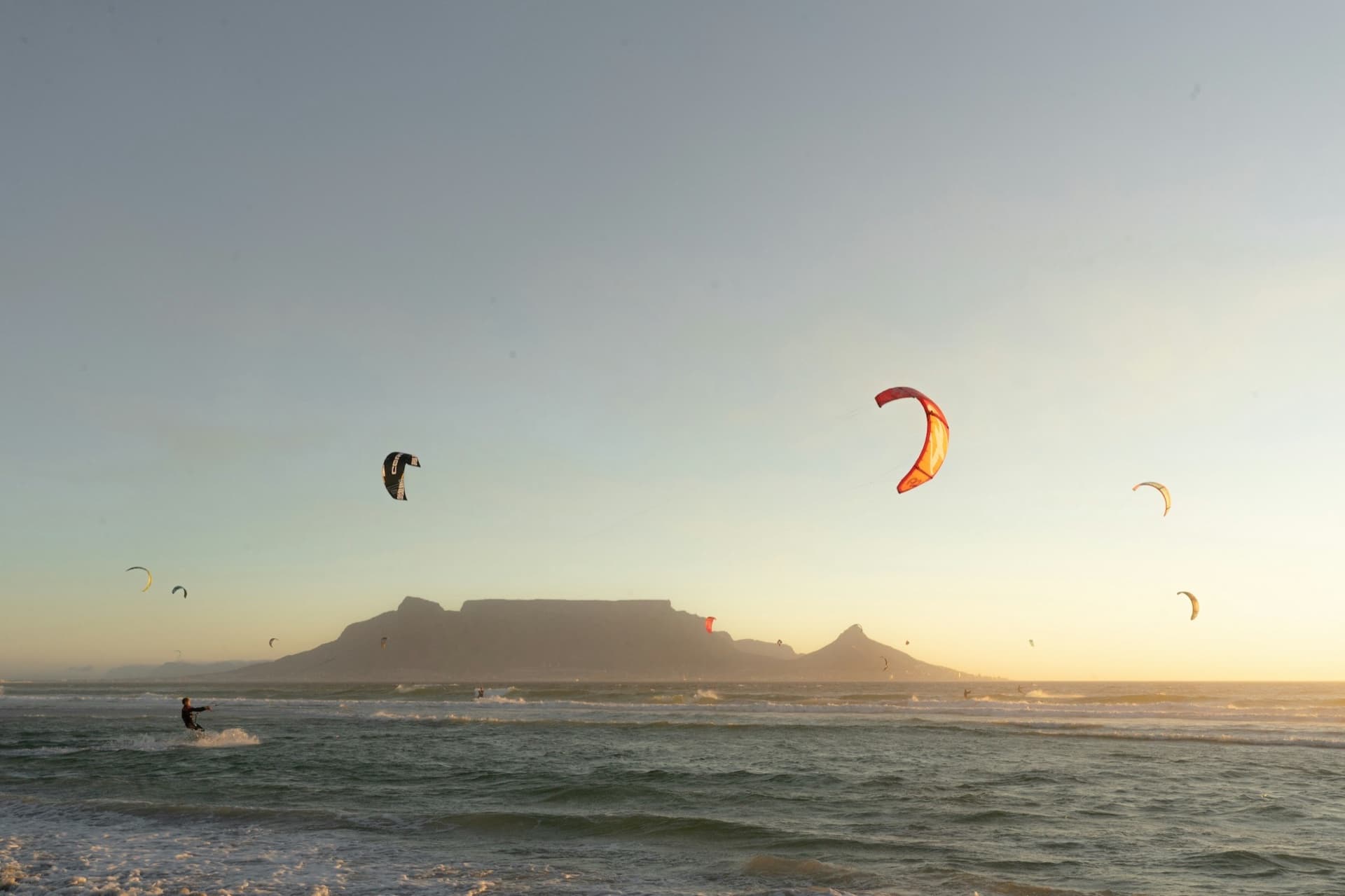
Cape Town is one of the great wind cities of the world. From November to March, while Europe shivers, the Cape Doctor pours down off Table Mountain and turns the Atlantic seaboard into a kitesurfing playground, with the mountain itself as the backdrop. It is high summer in the Southern Hemisphere: the wind is relentless, the water is bracing, and the scenery is almost unfair.
The wind: the Cape Doctor
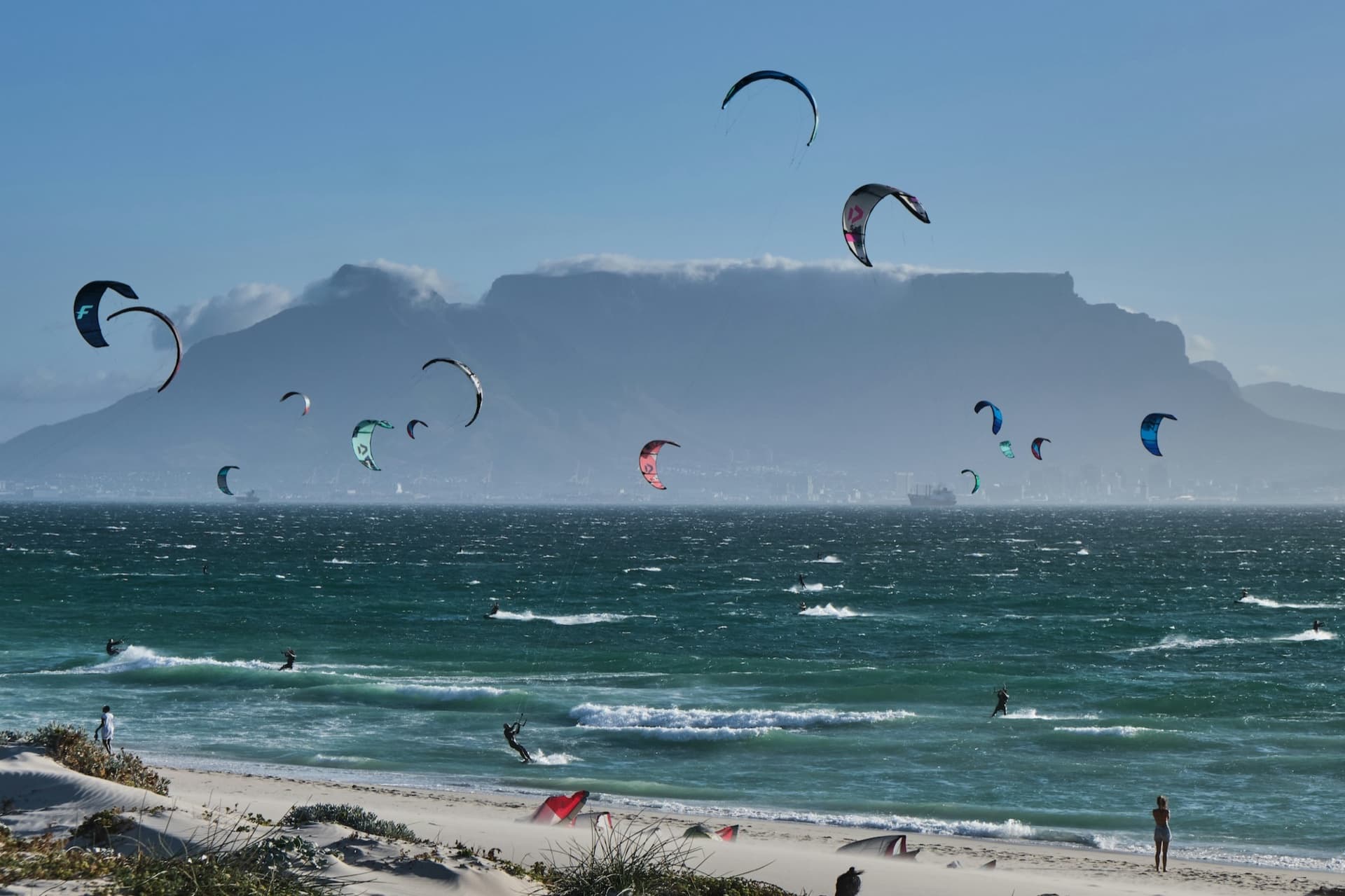
The wind here is the Cape Doctor, a strong southeasterly that blows through the Cape summer (roughly November to March). It is a thermally reinforced gradient wind: high pressure sits to the south, air accelerates around the mountains, and the "tablecloth" of cloud spilling over Table Mountain is the visible sign it is on. When it blows, it blows hard, often 25 to 35 knots for days at a stretch, which is why Cape Town is a small-kite destination and why it draws the world's pros for the southern summer. It is gusty close under the mountain, so the open beaches ride cleaner than the city bowl. Sizing down is the norm here, so it pays to know what size kite suits the strong stuff.
Bloubergstrand: Big Bay and the view
The heart of it is Bloubergstrand, the stretch of coast about 20 minutes north of the city with the postcard view of Table Mountain across the water. Big Bay is the main launch: a wide beach with flat water inside the reef and waves outside, room for hundreds of kites, and that iconic backdrop. Along the same sand, Kite Beach and Dolphin Beach are flatter and a little more sheltered, good for freestyle and for finding space on a busy day. The Cape Doctor here blows cross-onshore, which keeps it safe and carries you back to the beach.
Beyond the city: Langebaan and the Peninsula
An hour up the West Coast, Langebaan is the flat-water antidote: a huge turquoise lagoon, waist-deep for hundreds of metres, side-onshore wind, and a calmer scene that makes it the region's best place to learn or to ride a foil. South of the city, the Cape Peninsula holds the wave spots, where Witsand and Misty Cliffs face the cold Atlantic swell with serious wind and water for experienced riders only.
When to go
The season is the Southern Hemisphere summer, November to March, with the windiest, most reliable stretch from December to February. This is the off-season for Europe and the Caribbean, which is exactly why Cape Town fills with travelling kiters chasing wind through the northern winter. The catch is the water: the Atlantic here is cold, pushed up from the deep by the same southeasterly that brings the wind, so expect 12 to 17°C and pack a 4/3 or 5/3 wetsuit even at the height of summer.
Before you go
Fly into Cape Town International, 20 to 30 minutes from Bloubergstrand. A car is essential: the wind can be firing on the West Coast and dead in the city, or the reverse, and you will want to chase it between Big Bay, Langebaan and the Peninsula. Bring a small quiver, since 7 to 9 m days are the norm and a hard Cape Doctor calls for a 6. For another wind-sure escape in the northern winter, compare it with Dakhla on the Atlantic coast of Morocco.
Check the live Big Bay forecast and the Langebaan conditions to see how the Cape Doctor is lining up before you book.