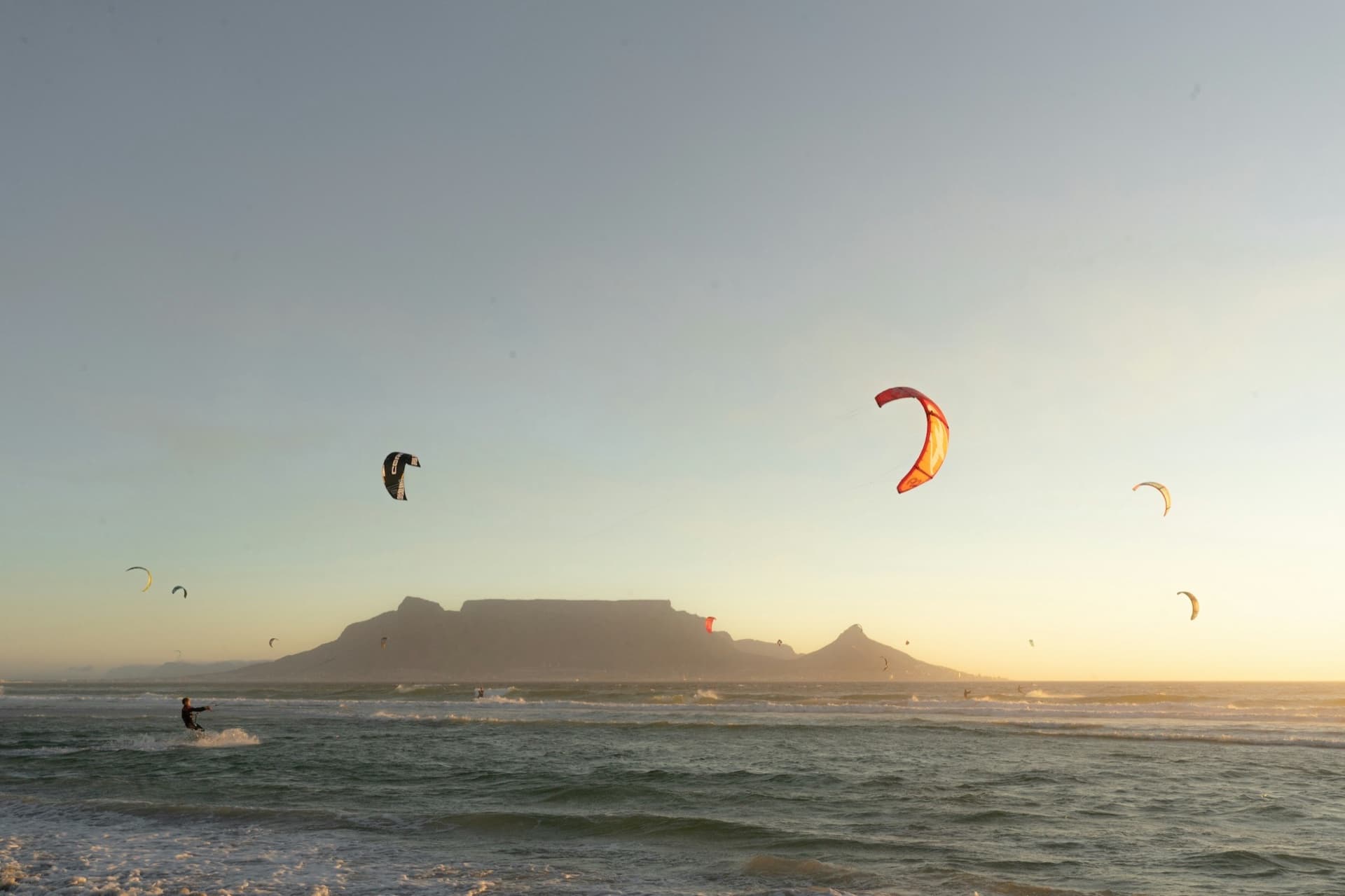
Wave riding asks for the opposite of a learner spot. Instead of flat, sheltered water you want a real ocean swell, and instead of any old breeze you want wind that blows across the wave or slightly off it, so you can ride down the face under a drifting kite rather than getting hauled over the falls. That pairing, quality swell plus side-shore or cross-off wind, is rarer than it sounds, and the best wave spots on earth are the handful of places where the coastline, the prevailing wind, and the swell window all line up. Most of them reward experience, because you are steering a kite and reading a breaking wave at the same time, often over a reef. If you are still learning to read the ocean, our guide to reading a surf forecast covers swell height, period, and direction, the three numbers that decide whether a wave spot turns on. These are the six we would pack a strapless board and a spare leash for.
Cape Town, South Africa
The southern summer turns the Cape into a wave-riding arena. From November to March the southeaster known locally as the Cape Doctor blows hard and cross-shore down the Atlantic seaboard, most days from late morning. Big Bay and Sunset serve up rippable walls, Table View has the space for big-air freeriders, and the brave chase heavier swell at the outer reefs. It is strong, cold-water kiting; the Atlantic here rarely climbs out of the mid-teens Celsius, so a 4/3 wetsuit and booties are standard kit. The Cape Town schools know which beach matches the wind and swell on any given day. See the Cape Town guide and the live forecast.
Le Morne, Mauritius
Home of One Eye, one of the most photographed waves in the sport: a fast, hollow left that peels off the reef under the shadow of Le Morne mountain. The southeast trades blow side-shore over warm, clear water, and the lagoon inside gives you a flat staging area before you commit to the reef outside. This is advanced riding over sharp, shallow coral, so most people build up to it, and the prime wind runs from May to September. Manawa, the reef next door, is a friendlier place to start. The Le Morne centres can guide your first reef sessions. Read the Le Morne guide or check conditions.
Ponta Preta, Sal (Cape Verde)
A long, powerful right-hand point that draws wave riders from across the world. The northeast trades come in cross-off, grooming clean walls you can ride for a small age, and Sal's season runs roughly November to June with warm water that needs no more than a shorty. Ponta Preta breaks best on a solid swell and is a spot for confident riders; on smaller days the island's bump-and-jump at Kite Beach and Santa Maria keeps you busy. The Sal schools run coaching and downwinders along the coast. See the Sal guide and the Ponta Preta forecast.
Dakhla, Morocco
Most people know Dakhla for its flat beginner lagoon, but the ocean side is a wave rider's secret. Outside the peninsula, Atlantic swell wraps into cross-shore trade wind at spots like Pointe de l'Or, with a fraction of the crowds you find at Europe's name breaks. It is bombproof for wind, blowing most days from April to September, so a wave trip here rarely gets skunked, and the same camps that teach beginners will shuttle you out to the waves. Cool upwelling water means a full wetsuit. Read the Dakhla guide, find a camp, and watch the live wind.
Taíba, Brazil
The Brazilian northeast is a strapless dream from July to January, when the Alísios trade winds blow cross-off almost every afternoon and sculpt long, gentle down-the-line walls over sandbanks in warm, boardshort water. Taíba's point and the neighbouring beaches let you link turn after turn with the wind at your back, which makes this one of the friendliest places anywhere to learn to ride waves before you step up to reef. String several spots together on a classic Ceará downwinder for the full experience. The Brazil schools run the coast daily. See the Brazil guide and the Taíba forecast.
Essaouira, Morocco
The old Portuguese port catches strong Atlantic trades that funnel down the medina bay, blowing cross-shore over a run of beach breaks and points. It has a long windsurf and kite heritage, warm-enough water in the windy months, and a walled town of galleries and fish grills for when it drops. The wind builds through the afternoon and peaks in spring and summer, and the forgiving beach breaks are a good place to find your feet before you graduate to the reefs and points down the coast toward Sidi Kaouki. Check the live forecast and time it for a cross-shore blow.
How to choose
Match the spot to your level and to the wind you want at your back. Warm water and forgiving walls to learn on: Taíba or Essaouira. World-class reef and point waves for confident riders: Le Morne and Ponta Preta. Raw power, swell, and a big-air culture: Cape Town. A near-guarantee the wind shows up: Dakhla. Wherever you go, read the swell and the wind together rather than the wind alone, because a wave spot with no swell is just choppy water. Book a wave-focused school if the break is new to you, keep the right kite sizes in the bag for gusty offshore days, and check the live forecast before you commit to the drive.